
A 200 amp service upgrade replaces the equipment that brings power into your home: the panel, usually the meter base, and often the wires that connect them to the utility. Most homeowners pay a few thousand dollars when only the panel and meter base change, and a good deal more when the utility line, mast or underground lateral must change too. The work needs a permit and a licensed electrician, and it is worth doing when your home is short on capacity, not simply because 200 amps is the next size up. Here is how to decide, what to expect and how to avoid the usual surprises.
AAPEX Electric is a family-owned electrical company in Port St. Lucie that has been doing electrical work for over 35 years. We replace panels and upgrade circuit breakers for homeowners and businesses across the Treasure Coast, with close attention to local codes.
TL;DR
- A 200 amp upgrade makes sense when breakers trip often, the panel is full, you have a fuse box or an old panel, or you plan big loads such as an EV charger, a heat pump, a pool or an addition.
- Panel-only work typically costs $1,000 to $2,500 according to ENERGY STAR, and a utility service upgrade can add thousands more.
- Upgrading the service is more than swapping the panel: the meter base, mast, grounding and the utility connection are part of it.
- The work is permitted and inspected, and in Florida it should be done by a licensed electrical contractor.
- Ask for a load calculation first. It tells you whether you need 200 amps, or whether a smaller change is enough.
Table of Contents
- What a 200 amp service upgrade actually includes
- Signs your home needs 200 amps
- Do you need 200 amps, or something smaller?
- How much does a 200 amp service upgrade cost?
- Code rules that apply when the service is replaced
- Permits, inspections and the utility
- Can you upgrade without rewiring the house?
- How many breakers fit in a 200 amp panel?
- What to ask before you hire
- Getting your upgrade done on the Treasure Coast
- FAQ
- Sources
What a 200 amp service upgrade actually includes
People use “panel upgrade” and “service upgrade” as if they were the same job. They overlap, but they are not identical.
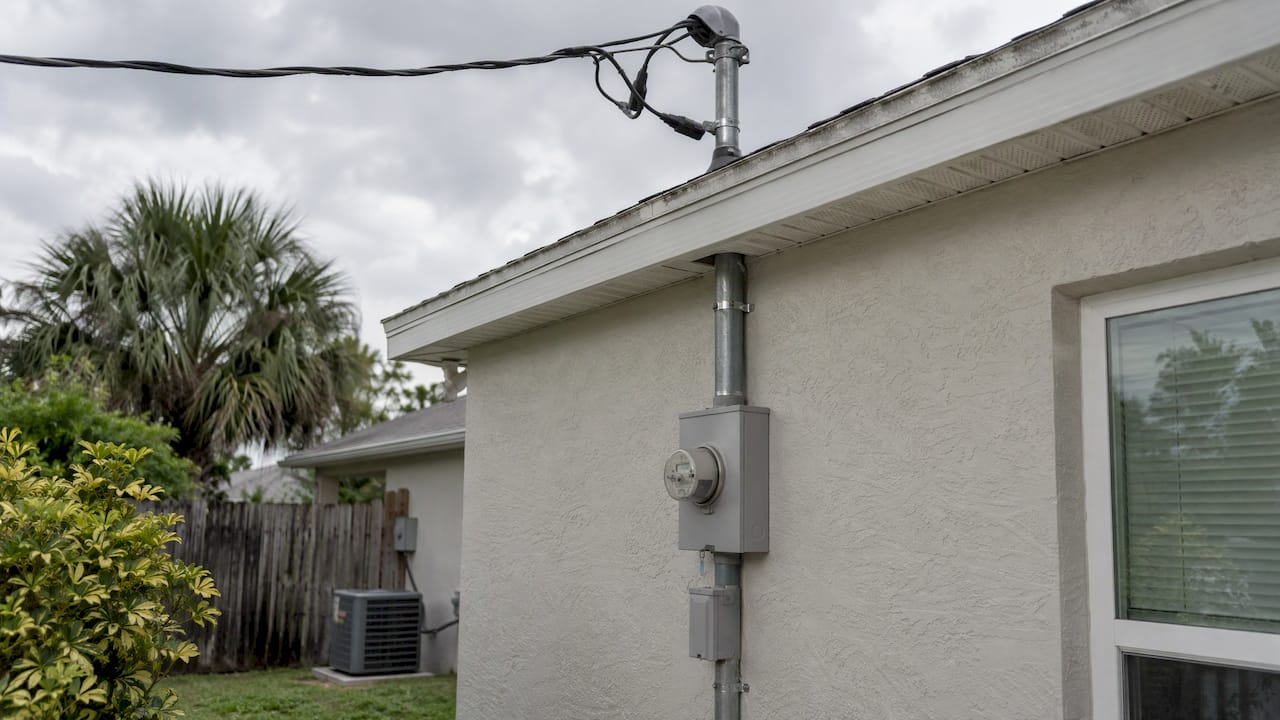
The service is everything between the utility’s lines and your main breaker: the service wires (overhead from a pole, or underground from a transformer), the meter base where the utility’s meter sits, the mast or conduit that carries the wires, and the main disconnect. The panel (also called the breaker box or load center) is the box that splits power into the circuits in your house.
A 200 amp service upgrade usually means:
- a new 200 amp panel with a 200 amp main breaker;
- a new meter base rated for 200 amps, if the old one is not;
- service conductors (the heavy wires) sized for the higher current;
- new grounding and bonding connections;
- a surge protective device, which current code requires when service equipment is replaced (more on that below);
- reconnection of every existing circuit, with each breaker labeled.
When the old panel is in good shape, it can sometimes stay in place as a subpanel fed from the new main panel. NYSERDA’s installer guide notes that converting a well-maintained 100 amp panel to a subpanel can save on rewiring costs. Whether that is appropriate depends on the panel’s age and condition, which is something an electrician has to see in person.
A panel replacement alone, with the same amperage, is a smaller job. It is what you do when the box is worn, recalled or out of space but the service size is still enough. If you are comparing quotes, check that each one says whether it covers the meter base, the mast and the service wires. A low quote that leaves them out is not comparable to one that includes them.
Signs your home needs 200 amps
Amperage is a measure of how much current your home can draw at one time. Think of it as the width of the pipe. If you try to run more through it than it was built for, protective devices trip, or worse, wires run hot.
This Old House lists the common reasons to upgrade: frequent tripped breakers, outdated wiring or an old fuse box, major new appliances or an addition, and a panel that is already at capacity. In practice, look for these:
- Breakers that trip when you run normal loads together, for example the dryer, oven and air conditioner.
- A fuse box, or a panel with no open breaker spaces.
- A panel with scorching, buzzing, rust or a burning smell. Call an electrician right away.
- Extension cords and power strips doing the job of missing circuits.
- A planned addition, pool, hot tub, workshop, generator or EV charger.
Age matters too. NYSERDA’s guide says homes with panels under 100 amps, or built before 1965, are likely to need more capacity, while homes already above 200 amps are unlikely to need an upgrade. It specifically flags pre-1950 homes with fuse boxes and 100 amp homes with no free breaker slots as candidates.
The federal BENEFIT factsheet on electric panels adds a useful rule: the code requires a service panel of at least 100 amps, and if your existing load plus the new load you plan is below the panel’s capacity (NEC 220.87), the panel does not need upgrading. That is why the load calculation matters.
Why Florida homes hit the limit sooner
Florida homes run air conditioning for much of the year, and many also carry electric water heaters, pool pumps, dryers and ranges. Add a heat pump, an EV charger or a backup generator and a 100 amp service can be crowded quickly. Homes in coastal Treasure Coast communities also deal with salt air and humidity, which age panels and breakers faster. We cover that in our guide for Jensen Beach homeowners and coastal panel conditions.
Do you need 200 amps, or something smaller?
The honest answer comes from a load calculation, not a rule of thumb. An electrician adds up the demand of your lighting, receptacles, HVAC, water heater, range, dryer, pool equipment and any planned additions using the method in the National Electrical Code (NEC), the model standard that most U.S. states, including Florida through its building code, build on.
This Old House’s Scott Caron stresses that the calculation should confirm 200 amps is appropriate rather than defaulting to the next size up, and it should include HVAC, EV chargers and future additions.
A simple worked example shows the logic. Say you have a 100 amp home with a full panel, central air, an electric water heater and range, and you want to add a Level 2 EV charger and a pool pump. The new loads may push your calculated demand past what 100 amps can safely handle, and there is no space for new breakers. That is a clear case for 200 amps. Now say you have a 150 amp panel with open spaces and plan to add one circuit. You may not need a service upgrade at all.
If you plan an EV charger, see how an electrician can prepare your home for EV charging. We install EV charging solutions, and the panel’s capacity is the first thing to settle.
How much does a 200 amp service upgrade cost?
There is no single price, because the job ranges from a panel swap to a full change of the utility connection. Published guidance from public sources gives these ranges:
| Scope of work | Typical range | Source |
|---|---|---|
| Panel upgrade only | $1,000 to $2,500 | ENERGY STAR and MyEnergy.NY.gov |
| Panel, labor and rewiring | $2,000 to $4,000 | Rewiring America |
| Each new dedicated circuit | $300 to $1,000 | ENERGY STAR |
| Utility service upgrade | $2,000 to $30,000 | ENERGY STAR |
| Service upgrade or transformer replacement, especially with underground wires | $5,000 to $25,000 | Rewiring America |
These are published sample ranges, and the dates and regions behind them differ, so use them to understand scale, not as a quote. For a real number, you need someone to look at your service.
What moves the price
- Meter base and mast condition. An old or corroded meter base has to be replaced to carry 200 amps.
- Overhead or underground service. Underground wires mean trenching or conduit work, which is where costs climb.
- Distance from the panel to the meter and the utility connection. Longer runs need more heavy wire.
- Number of circuits and how accessible the wiring is. MyEnergy.NY.gov says cost varies with circuits added, wiring length and access.
- Permit fees and utility coordination.
- Code items that come with replacement, such as the surge protective device and grounding updates.
MyEnergy.NY.gov also advises coordinating electrical work with remodeling to save money. If a kitchen remodel, addition or new HVAC system is coming, upgrading the service at the same time avoids opening walls twice. Our pre-wiring service for remodels and new construction is built for exactly that kind of overlap.
Code rules that apply when the service is replaced
When you replace service equipment, the new equipment has to meet the code in force today, not the code your house was built under. Three things come up most often.
Surge protection. The 2020 NEC introduced Section 230.67, which requires a Type 1 or Type 2 surge protective device on services supplying dwelling units, including when service equipment is replaced. Leviton’s NEC summary says the 2023 edition extended this to more occupancies and calls for a discharge rating of at least 10 kA.
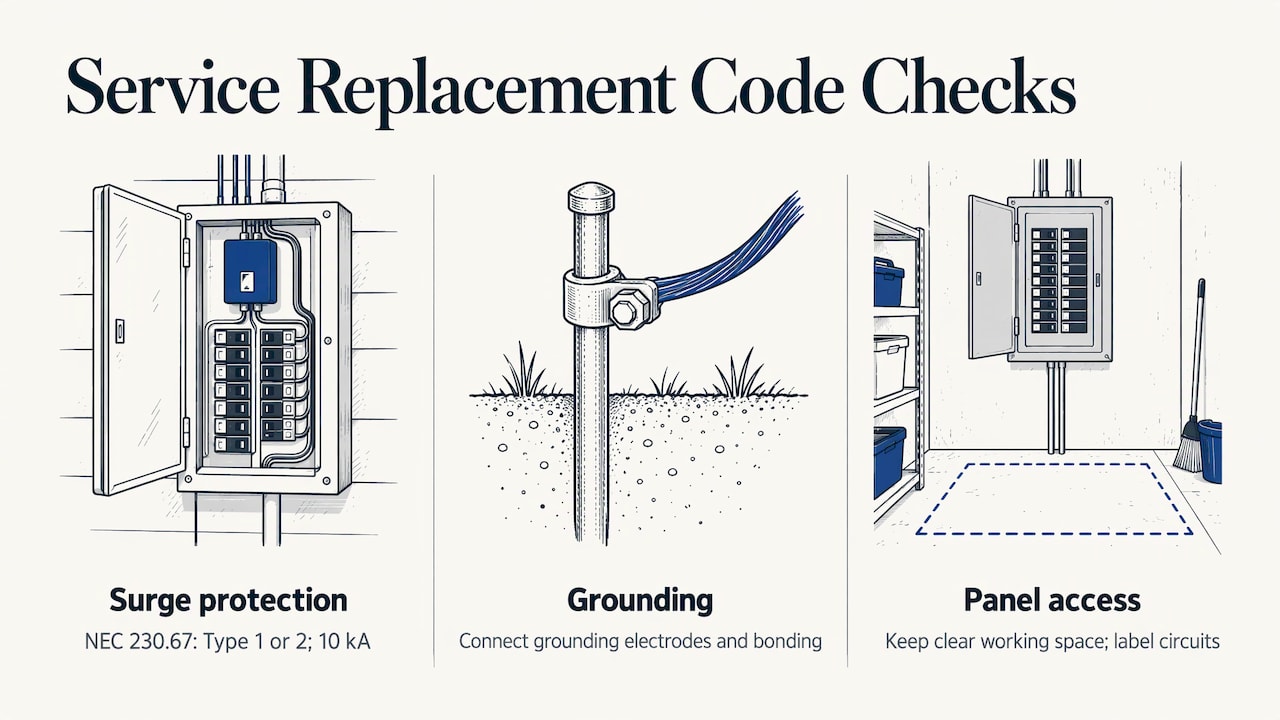
Grounding and bonding. The new service needs correct grounding electrode connections and bonding. This is a leading reason older homes cannot simply have a bigger breaker dropped in.
Working clearances and labeling. The panel needs clear working space in front of it, and every circuit must be identified.
Florida adopts its own building code, and the 2023 Florida Building Code, Residential, Eighth Edition took effect on December 31, 2023. Counties and cities in our area, including Martin, St. Lucie, Indian River and Palm Beach, enforce it through their building departments, and local requirements and the utility’s meter standards can add to it. That is why local code knowledge matters on this job, and why it is central to how we work.
Permits, inspections and the utility
A service upgrade is not a job where permits are optional. The typical sequence is:
- Load calculation and scope. The electrician decides the service size and what must be replaced.
- Permit. The licensed contractor applies through the local building department.
- Utility coordination. If the meter must be disconnected and reconnected, or the service lines change, the electric utility has to be involved. Rewiring America warns that utility-coordinated service upgrades are a key timeline risk, and in some regions they cause scheduling delays of months.
- On-site work. The old equipment comes out, the new panel and meter base go in, and circuits are reconnected. Power is off while this happens, so plan for a day without electricity and move anything sensitive, like medical devices, to a backup plan in advance.
- Inspection. The building inspector checks the work before the utility restores or finalizes service.
- Reconnection and labeling. Power comes back on, and you get a labeled panel.
The on-site work is usually the short part. Waiting for approvals and the utility is what stretches the calendar. Ask your electrician early what the typical wait is in your county.
Why a licensed contractor matters
Panel and service work in Florida is for licensed electrical contractors. A licensed contractor can pull the permit, and the work is inspected against the code. Unlicensed work can fail inspection, cause trouble with insurance or at resale, and create real fire and shock hazards. Our page on the credentials that separate a licensed electrician in Stuart from an unlicensed handyman explains what to look for. Working inside a panel also means live conductors at the service entrance that stay energized even with the main breaker off, which is one reason this is not a job for do-it-yourself work.
Can you upgrade without rewiring the house?
Often yes. The upgrade changes the service and the panel. The branch circuits, which are the wires running to outlets, lights and appliances, can usually be reconnected to the new panel as long as they are in good condition and correctly sized.
What can force more work:
- Ungrounded outlets or old cloth-sheathed wiring. These are common in homes from the 1950s and earlier and are worth addressing when the panel is open.
- Aluminum branch wiring or damaged insulation.
- Circuits that were overloaded or modified by earlier owners.
A home safety inspection is a good first step. Ours covers shock hazards, grounding systems, panel labels and fire detectors, which are the same items that decide how much work an upgrade will involve.
How many breakers fit in a 200 amp panel?
A typical 200 amp residential panel has 40 spaces. Some panels accept tandem breakers (two circuits in one space) in approved positions, which can raise the circuit count. The limit is set by the manufacturer’s listing, not by a universal number. Structure Tech’s explanation of NEC 408.54 describes how the code defers to what the panel was designed, rated and listed for, and why tandems in non-rated positions can create hazards.
The real capacity limit is your calculated load. A full 200 amp panel does not mean you are out of capacity, and an empty one does not mean you have unlimited capacity. Having spaces matters for future circuits, which is a good reason to choose a panel with room to grow.
What to ask before you hire
Whether you call us or anyone else for a quote, ask for these in writing:
- The load calculation or the reasoning behind the 200 amp size.
- Whether the meter base, mast and service wires are included.
- Who applies for the permit and what inspections follow.
- What the plan is for the utility disconnect and reconnect, and how long you will be without power.
- Whether the new panel includes a surge protective device and updated grounding.
- How many open spaces the finished panel will have.
Property managers and HOA boards should also ask about common-area meters, pool and clubhouse equipment and any planned EV charging or generator loads, so the service is sized for the whole property. We handle those through our HOA electrical services.
Getting your upgrade done on the Treasure Coast
If your breakers trip, your panel is full or a big new load is coming, the next step is an on-site look at your service. AAPEX Electric replaces electrical panels and upgrades circuit breakers for homes and businesses in Port St. Lucie, Stuart, Fort Pierce, Vero Beach, Jupiter and the surrounding Treasure Coast. We are family-owned, with over 35 years of experience, and we focus on local codes, safety and finishing on time.
See our electrical panel replacement and upgrade services, or contact us through our website to talk through your home.

We also provide home safety inspections, electrical troubleshooting and repairs, so if you are not sure whether you need an upgrade, we can look at the whole picture.
FAQ
How much does it cost to upgrade to 200 amp service?
Panel-only upgrades are commonly cited at $1,000 to $2,500, and $2,000 to $4,000 once labor and rewiring are included. If the utility service, mast or an underground line must change, costs rise well above that. An on-site assessment is the only way to get a firm number.
Can you upgrade an electrical panel without rewiring the house?
In many cases, yes. Existing circuits are reconnected to the new panel if their wiring is in good condition. Damaged, ungrounded or outdated wiring may need repair or replacement while the panel is open.
Should a 50 year old electrical panel be replaced?
Age alone does not decide it, but a panel that old deserves an inspection. Look for a fuse box, no open spaces, frequent tripping, rust, scorch marks or breakers that feel loose. NYSERDA’s guidance treats homes built before 1965 as likely to need more capacity.
Do I need a permit for a 200 amp service upgrade?
Yes. Service and panel replacement is permitted work, and the finished job is inspected by the local building department. A licensed electrical contractor applies for the permit.
How long will my power be off?
On-site work is usually limited to a day, and power is off for part of it. The longer wait is typically permit approval and utility scheduling, which Rewiring America says can take months in some regions.
Sources
- This Old House: How to upgrade an electric meter and panel to 200 amp service
- BENEFIT factsheet: Home electrification and electric panel upgrades
- NYSERDA: The Heat Pump Installer’s Guide to Assessing Residential Electric Service
- ENERGY STAR: Make Your Home Electric Ready
- MyEnergy.NY.gov: Electrical Panel Upgrades
- Rewiring America: Pros and cons of a panel upgrade
- Leviton: NEC code requirements for surge protection
- 2023 Florida Building Code, Residential, Eighth Edition, Part VIII Electrical
- Structure Tech: Inspecting tandem circuit breakers